Quick Summary: Build a genius, simple nightstand with this beginner-friendly woodworking project! Learn to create a functional and stylish piece of furniture using basic tools and techniques. Perfect for adding a custom touch to your bedroom decor.
Hey there, fellow DIYers! Jack Shaffer here, your guide from Nailerguy. Ever look at your bedroom and think, “I need a better place for my lamp, my book, and my alarm clock”? A nightstand is a must-have, but sometimes the ones you find in stores just don’t fit your style or your budget. Or maybe you’re just ready to dive into woodworking and want a rewarding first project. You’re in the right place! Building your own nightstand might sound a bit daunting, but trust me, it’s totally achievable, even if you’re just starting out. We’re going to break down a super simple yet genius design that’s perfect for beginners. So, grab your safety glasses, and let’s get building!
This project focuses on clean lines and smart construction, meaning fewer complicated cuts and more satisfying assembly. We’ll cover everything from the tools you’ll need to the step-by-step process. Get ready to impress yourself (and maybe your significant other!) with a custom piece of furniture.
Table of Contents
Why This Simple Nightstand Design is Genius


What makes this nightstand design stand out for beginners? It’s all about simplicity and effectiveness. We’re focusing on a design that uses straightforward joinery – no fancy dovetails or complex joinery techniques required here. This means you can achieve a strong, stable, and good-looking nightstand without needing advanced skills or specialized tools.
- Easy Assembly: We’re prioritizing simple butt joints reinforced with screws or nails, which are perfect for beginners.
- Minimal Waste: The design is planned to make good use of standard lumber sizes, reducing material waste and saving you money.
- Customizable: While the design is simple, it offers plenty of room for personalization. You can easily adjust dimensions or add your own decorative touches later.
- Sturdy and Functional: Despite its simplicity, this nightstand will be robust enough to hold your nighttime essentials and look great doing it.
Tools and Materials You’ll Need


Before we start cutting, let’s gather everything we need. Having the right tools and materials ready makes the process smooth and enjoyable. Don’t worry if you don’t have everything; many of these are standard DIY tools you can find at your local hardware store or online from reputable retailers.
Essential Tools:
- Safety Glasses: Non-negotiable! Always protect your eyes when working with tools.
- Measuring Tape: For accurate measurements.
- Pencil: To mark your cuts.
- Miter Saw or Circular Saw: For making straight, accurate cuts on your wood. A miter saw is great for repetitive precise cuts, but a circular saw with a guide can also work well for beginners. You can learn more about choosing the right saw for your projects at sites like Popular Mechanics.
- Drill/Driver: For pre-drilling pilot holes and driving screws.
- Clamps: Essential for holding pieces together while you drive fasteners or glue sets. Bar clamps or pipe clamps are very useful.
- Sandpaper or Orbital Sander: For smoothing out rough edges and surfaces. Start with a medium grit (like 120) and finish with a fine grit (like 220).
- Hammer (Optional): If you choose to use nails instead of screws.
- Wood Glue: Adds extra strength to your joints.
Materials:
For this project, we’ll be using common lumber such as pine, poplar, or even plywood. Pine is affordable and easy to work with, making it a great choice for beginners. We’ll assume standard 1×12 (which is actually ¾” x 11 ¼”) and 1×4 (which is actually ¾” x 3 ½”) lumber for this design. It’s always a good idea to buy a little extra material than you think you’ll need in case of mistakes.
- One 8-foot 1×12 board (for the sides and top)
- One 8-foot 1×4 board (for the apron/support pieces)
- 1 ¼-inch wood screws or finishing nails
- Wood glue
- Sandpaper (120 and 220 grit)
- Wood finish (paint, stain, or polyurethane)
Tip: Make sure to select straight boards with minimal knots for the best results. Lumber quality can vary, so take your time at the store.
Cutting List

Accuracy in cutting is key to a successful build. Measure twice, cut once! Here’s our cutting list for a basic nightstand around 24 inches tall and 12 inches wide.
| Part Name | Board Size | Quantity | Cut Length | Notes |
|---|---|---|---|---|
| Sides | 1×12 | 2 | 24 inches | |
| Top | 1×12 | 1 | 14 inches | This allows for a slight overhang. |
| Bottom Shelf | 1×12 | 1 | 11 ¼ inches | This will fit snugly between the sides. |
| Front Apron | 1×4 | 1 | 9 inches | This sits under the top. |
| Side Aprons | 1×4 | 2 | 2 inches | These add stability. |
| Back Apron | 1×4 | 1 | 9 inches |
The actual width of the assembled nightstand will be approximately 12 inches (the width of the 1×12 boards). The depth will be about 11 ¼ inches (the width of the bottom shelf). The height will be around 24 inches (the height of the side pieces).
Step-by-Step Assembly Guide

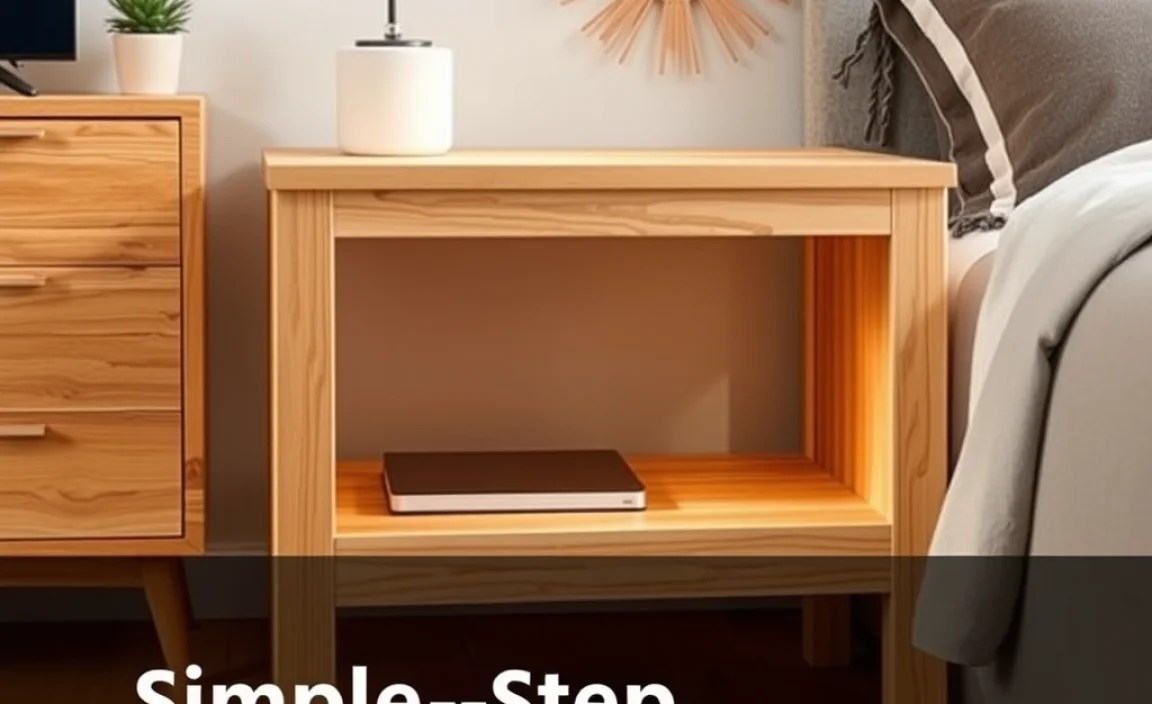
Now for the fun part! Let’s bring this nightstand to life. Remember to wear your safety glasses throughout the process.
Step 1: Cut Your Pieces
Using your chosen saw (miter or circular), carefully cut all the pieces according to the cutting list above. Ensure your cuts are as square as possible. If using a circular saw, a straight edge or a cutting guide will help immensely. For tips on making straight cuts with a circular saw, check out resources from Family Handyman.
Step 2: Sand Everything Smoothly
Before assembly, it’s much easier to sand all your cut pieces. Start with 120-grit sandpaper to remove any saw marks or rough edges. Then, follow up with 220-grit sandpaper for a smooth finish. Wipe away all the dust with a tack cloth or a damp rag.
Step 3: Assemble the Box (Sides and Bottom Shelf)
Take your two side pieces (24″ 1x12s) and your bottom shelf piece (11 ¼” 1×12). Decide how high you want your bottom shelf to be. A good starting point is about 4 inches from the bottom of the side pieces. Mark this line on the inside of both side pieces. Apply wood glue along the edges of the bottom shelf where it will meet the side pieces. Position the bottom shelf on your marked lines and clamp it in place. Pre-drill pilot holes through the side pieces into the edge of the bottom shelf to prevent the wood from splitting. Then, drive screws or nails to secure the shelf. You’ll likely need two screws or nails per side.
Tip: Pre-drilling pilot holes is crucial, especially when working with screws close to the edge of the wood. This prevents frustrating splits.
Step 4: Attach the Aprons
The apron pieces provide stability and a solid mounting point for the top. These are your 1×4 pieces. We have one front, one back, and two side aprons. The side aprons are very short (2 inches) and are essentially just to add a bit of rigidity before we attach the top. The front and back aprons will be 9 inches long.
Apply wood glue to the ends of the front and back aprons and position them between the side pieces, flush with the top edge of the side pieces. The 1×4 is only 3 ½ inches wide, so they will sit about 1 inch down from the top edges of the 1×12 sides once the top is added later, creating a nice reveal.
Clamp the front and back aprons in place. Pre-drill and drive screws or nails through the side pieces into the ends of the aprons. For the front and back aprons, you will also want to pre-drill and drive screws/nails from the front and back, going into the ends of the side pieces.
Now, take your two 2-inch side aprons. Glue and position these between the front and back aprons, flush with the top edge of the side pieces. Pre-drill and drive screws/nails through the front and back aprons into the ends of these shorter side aprons.
Visualizing the Aprons: Imagine the 1x4s forming a rectangle just under the top. The 9-inch pieces go front-to-back, and the shorter 2-inch pieces go side-to-side, connecting the front and back aprons. This creates a strong frame.
Step 5: Attach the Top
Apply wood glue generously to the top edges of the side pieces and the apron assembly. Center your 1×12 top piece (14 inches) over the body of the nightstand. You want an even overhang on the front and sides. A 1-inch overhang on the front and sides is a good starting point. Clamp the top securely in place.
From the inside of the nightstand, pre-drill pilot holes up through the apron pieces and into the underside of the top. Drive screws to secure the top. You can also pre-drill and drive screws down through the top into the aprons if you plan on filling the screw holes later with wood filler. For a cleaner look, most woodworkers prefer driving fasteners from underneath.
Step 6: Finishing Touches
Once the glue is dry and the nightstand is securely assembled, do a final light sanding with 220-grit sandpaper to smooth out any rough spots or glue squeeze-out. Wipe down the entire piece to remove dust.
Now you can apply your chosen finish. Paint, stain, or a clear coat of polyurethane will protect the wood and give it a beautiful look. Follow the manufacturer’s instructions for your chosen finish. Allow it to dry completely between coats.
Design Variations and Upgrades

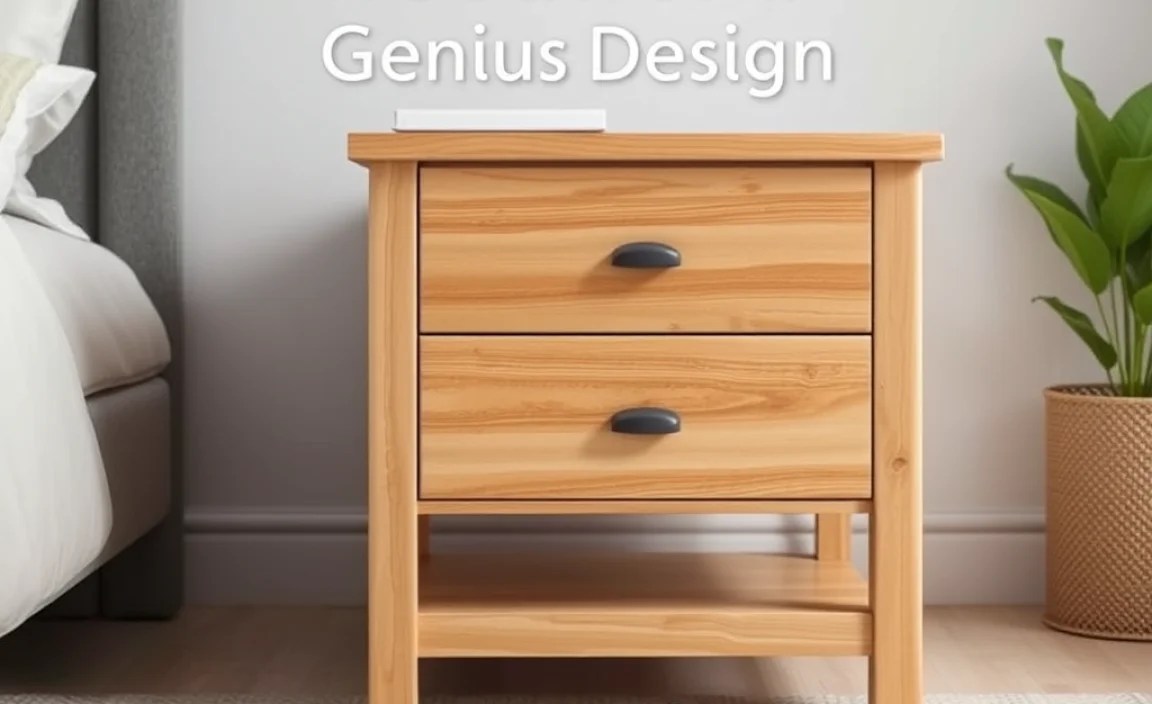
This simple design is a fantastic starting point. Once you’ve built it, you might want to try some modifications for future projects or even this one!
- Adding a Drawer: For a more advanced project, you could design and build a simple drawer to fit within the apron frame. This would involve adding drawer slides.
- Adjustable Shelf: Instead of a fixed bottom shelf, you could use shelf pins to make the shelf adjustable.
- Tapered Legs: For a more mid-century modern look, you could cut the side pieces with a slight taper from top to bottom.
- Different Top Material: Consider using a contrasting wood for the top, or even a piece of tile or stone for a unique look.
- Paint Colors: Don’t be afraid to use vibrant colors or a two-tone finish to match your room’s decor.
A Table of Dimensions for Common Nightstand Sizes
While our project targeted a specific size, nightstands come in various dimensions. Here’s a quick look at some common sizes, which can help you adjust the cutting list for your needs.
| Feature | Small Nightstand | Standard Nightstand | Large Nightstand |
|---|---|---|---|
| Height | 20-22 inches | 22-26 inches | 26-30 inches |
| Width | 14-18 inches | 18-22 inches | 22-26 inches |
| Depth | 14-16 inches | 16-18 inches | 18-20 inches |
| Top Overhang | 1-2 inches | 1-2 inches | 1-2 inches |
Remember, these are just guidelines. The “genius” part of this project is its scalability and adaptability to your specific space and aesthetic preferences. You can easily make this design taller, wider, or deeper by adjusting the lengths of the side, top, and shelf pieces, keeping the apron dimensions proportional.
